












|
|
|

|
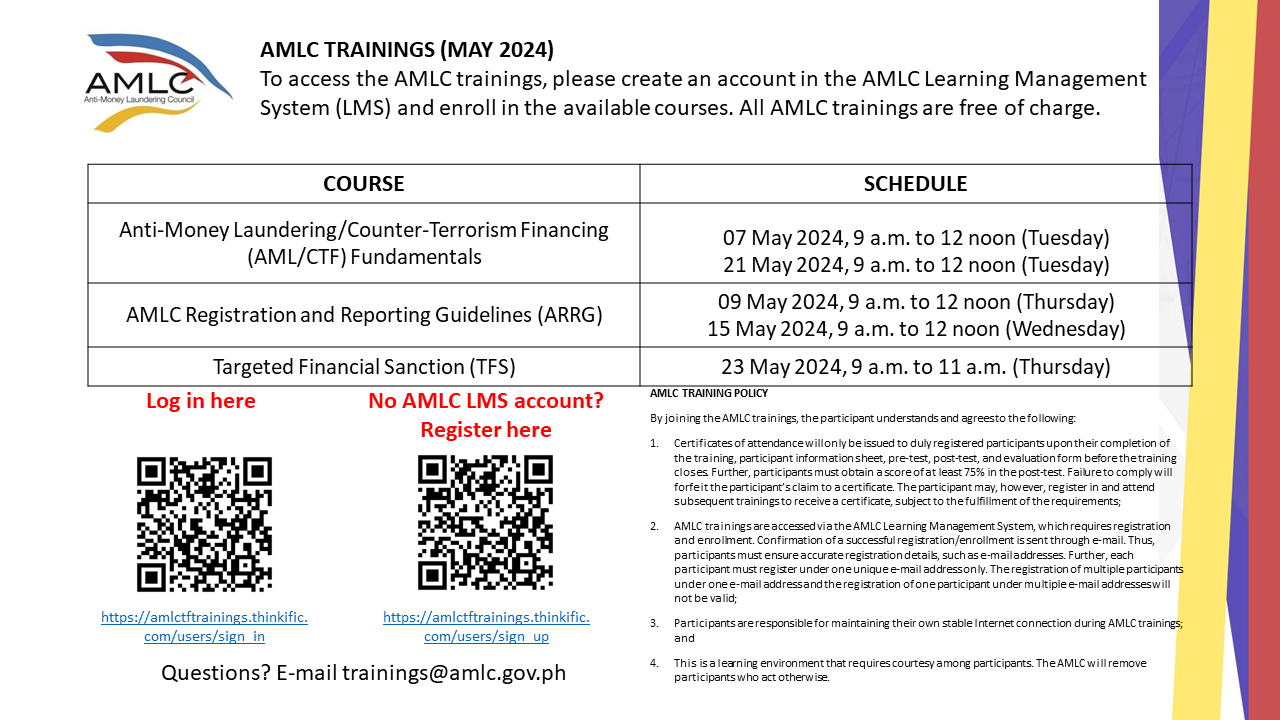
The Information Management and Analysis Group (IMAG) of the AMLC
Secretariat is conducting a detailed training on the AMLC Reporting
Procedures for electronic CTRs and STRs every last Wednesday of the month
at Room 507 EDPC Bldg., BSP Complex, corner A. Mabini & P. Ocampo
Sts., Malate, Manila.
Compliance officers and staff of institutions
covered by R.A. 9160, as amended by R.A. 9194 or the Anti-Money
Laundering Act of 2001 (AMLA) who are not yet compliant with the
reporting requirements are enjoined to attend this training. Interested
parties may call IMAG at 302-3848 or 521-7985 to register.
|

|
|

|

|

|
|
|
|

|
The Executive Director
AMLC Secretariat
5th Flr. EDPC Building
BSP Complex, Malate
Manila, Philippines
|
Phone:
|
+63-2-523-4421
|
|
Fax:
|
+63-2-524-6085
|
|
eMail:
|
|
|

|
|

|

|

|
|
|
|
AMLA AT A GLANCE
|
|
Rationale for Enacting the Law
|
|
The Philippines, while striving to sustain
economic development and poverty alleviation through, among others,
corporate governance and public office transparency, must contribute its
share and play a vital role in the global fight against money laundering.
Hence, the compelling need to enact responsive anti-money laundering
legislation in order to establish and strengthen an anti-money laundering
regime in the country which will not only increase investor’s confidence
but also ensure that the Philippines is not used as a site to launder
proceeds of unlawful activities.
[Back to top]
|
|
History of the Act
|
|
Republic
Act No. 9160 otherwise known as The Anti-Money Laundering Act of 2001 was signed
into law on September 29, 2001 and took effect on October 17, 2001. The Implementing Rules and Regulations took effect
on April 2, 2002. On March 7, 2003, R.A. No. 9194 (An Act Amending R.A. No. 9160) was
signed into law and took effect on March 23, 2003. The revised Implementing
Rules and Regulations took effect on September 7,
2003.
[Back to top]
|
|
Salient Features
|
|
§ Criminalizes money laundering
§ Creates a financial intelligence unit
§ Imposes requirements on customer identification, record keeping
and reporting of covered and suspicious transactions
§ Relaxes strict bank deposits secrecy laws
§ Provides for freezing/seizure/forfeiture/recovery of dirty
money/property
§ Provides for international cooperation
Money
Laundering
is a crime whereby the proceeds of an unlawful activity as defined in the
AMLA are transacted or attempted to be transacted to make them appear to
have originated from legitimate sources.
[Back to top]
|
|
Money Laundering Offenses and Penalties
|
|
§ Knowingly transacting or attempting to transact any monetary
instrument/property which represents, involves or relates to the proceeds
of an unlawful activity. Penalty is 7 to 14 years imprisonment and a
fine of not less than P3M but not more than twice the value of the monetary
instrument/property.
§ Knowingly performing or failing to perform an act in relation to
any monetary instrument/property involving the proceeds of any unlawful
activity as a result of which he facilitated the offense of money
laundering. Penalty is 4 to 7 years imprisonment and a fine of not
less than P1.5M but not more than P3M.
§
Knowingly failing to disclose and file with the AMLC any monetary
instrument/property required to be disclosed and filed. Penalty is 6
months to 4 years imprisonment or a fine of not less than P100,000 but not
more than P500,000, or both.
Unlawful
Activity is
the offense which generates dirty money. It is commonly called the
predicate crime. It refers to any act or omission or series or combination
thereof involving or having direct relation to the following:
[Back to top]
|
|
Predicate Crimes/Unlawful Activities
|
-
Kidnapping for ransom
-
Drug trafficking and related offenses
-
Graft and corrupt practices
-
Plunder
-
Robbery and Extortion
-
Jueteng and Masiao
-
Piracy
-
Qualified theft
-
Swindling
-
Smuggling
-
Violations under the Electronic Commerce Act of 2000
-
Hijacking; destructive arson; and murder, including those perpetrated
by terrorists against non-combatant persons and similar targets
-
Fraudulent practices and other violations under the Securities
Regulation Code of 2000
-
Felonies or offenses of a similar nature that are punishable under
the penal laws of other countries.
[Back to top]
|
|
Other Offenses/Penalties
|
|
§
Failure to keep records is committed by any responsible official or employee
of a covered institution who fails to maintain and safely store all records
of all transactions of said institution, including closed accounts, for
five (5) years from the date of the transaction/closure of the account. Penalty
is 6 months to 1 year imprisonment or a fine of not less than P100,000 but
not more than P500,000, or both.
§
Malicious reporting is committed by any person who, with malice or in bad
faith, reports/files a completely unwarranted or false information relative
to money laundering transaction against any person. Penalty is 6 months
to 4 years imprisonment and a fine of not less than P100,000 but not more
than P500,000, at the discretion of the court. The offender is not entitled
to avail the benefits of the Probation Law.
-
If the offender is a corporation, association, partnership or any
juridical person, the penalty shall be imposed upon the responsible
officers, as the case may be, who participated in, or allowed by their
gross negligence, the commission of the crime.
-
If the offender is a juridical person, the court may suspend or
revoke its license.
-
If the offender is an alien, he shall, in addition to the
penalties prescribed, be deported without further proceedings after serving
the penalties prescribed.
-
If the offender is a public official or employee, he shall, in
addition to the penalties prescribed, suffer perpetual or temporary
absolute disqualification from office, as the case may be.
§
Breach of confidentiality. When reporting covered or suspicious transactions to
the AMLC, covered institutions and their officers/employees are prohibited
from communicating directly or indirectly, in any manner or by any means,
to any person/entity/media, the fact that such report was made, the
contents thereof, or any other information in relation thereto. In case of
violation thereof, the concerned official and employee of the covered
institution shall be criminally liable. Neither may such reporting be
published or aired in any manner or form by the mass media, electronic mail
or other similar devices. In case of a breach of confidentiality published
or reported by media, the responsible reporter, writer, president,
publisher, manager and editor-in-chief shall also be held criminally
liable. Penalty is 3 to 8 years imprisonment and a fine of not less than
P500,000 but not more than P1M.
[Back to top]
|
|
Covered Institutions
|
|
§
Covered Institutions are those mandated by the AMLA to submit
covered and suspicious transaction reports to the AMLC. These are:
-
Banks and all other entities, including their subsidiaries and
affiliates, supervised and regulated by the Bangko Sentral ng Pilipinas
-
Insurance companies and all other institutions supervised or
regulated by the Insurance Commission
-
Securities dealers, pre-need companies, foreign exchange corporations
and other entities supervised or regulated by the Securities and Exchange
Commission
[Back to top]
|
|
Covered & Suspicous Transactions
|
|
§
Covered transactions are single transactions in cash or other
equivalent monetary instrument involving a total amount in excess of Five
Hundred Thousand (P500,000) Pesos within one (1) banking day
§
Suspicious transactions are transactions with covered
institutions, regardless of the amounts involved, where any of the
following circumstances exists:
-
there is no underlying legal/trade obligation, purpose or economic
justification;
-
the client is not properly identified;
-
the amount involved is not commensurate with the business or
financial capacity of the client;
-
the transaction is structured to avoid being the subject of
reporting requirements under the AMLA;
-
there is a deviation from the client’s profile/past
transactions;
-
the transaction is related to an unlawful activity/offense under
the AMLA; and
-
transactions similar or analogous to the above.
[Back to top]
|
|
Freezing of Monetary Instrument or
Property
|
|
The
Court of Appeals, upon application ex parte (without notice to the
other party) by the AMLC and after determination that probable cause exists
that any monetary instrument or property is in any way related to an
unlawful activity, may issue a freeze order which shall be effective
immediately. The freeze order shall be for a period of 20 days unless
extended by the court.
[Back to top]
|
|
Authority to Inquire into Bank Deposits
|
|
Notwithstanding
the provisions of R.A. No. 1405, as amended, R.A. No. 6426, as amended,
R.A. No. 8791, and other laws, the AMLC may inquire into or examine any
particular deposit or investment with any banking institution or non-bank
financial institution upon order of any competent court in cases of
violation of this act when it has been established that there is probable
cause that the deposits/investments are involved/related to an unlawful
activity as defined in Sec. 3(i) of the AMLA or a money laundering offense
under Sec. 4 thereof; except that
no court order shall be required in cases involving kidnapping for ransom;
drug trafficking and related offenses; and hijacking, destructive arson and
murder, including those perpetrated by terrorists against non-combatant
persons and similar targets.
[Back to top]
|
|