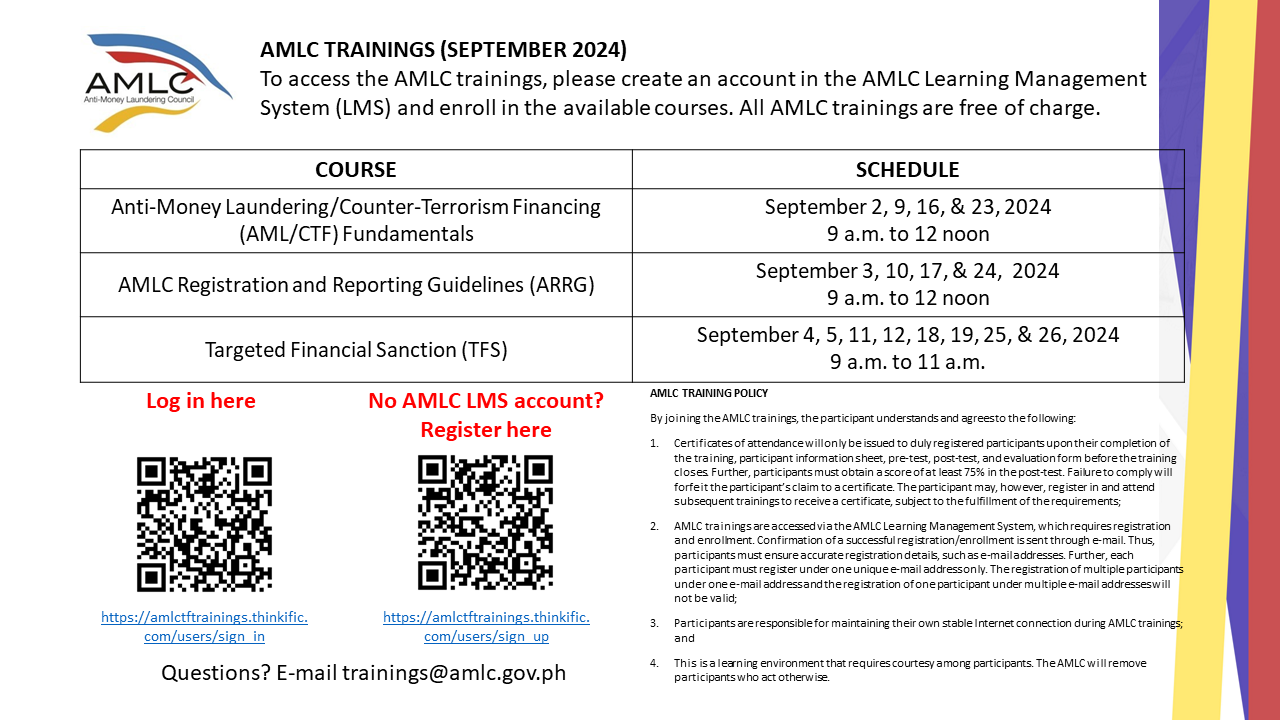

Pursuant to Item V-A, Part 1 of the 2021 AMLC Registration and Reporting Guidelines (ARRG), 22 - 24 July 2025 are declared as non-reporting days and are excluded in the counting of the prescribed reporting period.
Should you have any queries, you may refer to the ARRG Hotlines posted on the AMLC Website.
Advisory on Scam Incidents Involving Deepfakes Technology
Paalala mula sa Anti-Money Laundering Council (AMLC) kaugnay sa mga Pekeng Investment Scheme Gamit ang Deepfake Technology
The Anti-Money Laundering Council (AMLC) warns the public about the increasing misuse of Artificial Intelligence (AI), particularly deepfake technology, in fraudulent investment schemes.
Deepfakes are AI generated synthetic media such as videos, audio recordings, or images that falsely depict individuals as saying or doing things they never actually said or did.
Recently, scammers were now using this AI to create fake videos or voice recordings of well-known personalities, Chief Executive Officers (CEOs), or influencers to falsely endorse fake investment schemes to deceive the public.
The AMLC strongly urges the public to exercise due diligence and caution when encountering investment offers, especially those promoted through social media platforms or unsolicited messages. Individuals are advised not to rely solely on videos or online post as proof of legitimacy. Instead, always verify the authenticity of investment opportunities with Securities and Exchange Commission (SEC) at 8818-1898 or Bangko Sentral ng Pilipinas (BSP) at(632) 8811-1277
The public is also advised to report any incident or suspected use of deepfake technology in connection with scams or fraudulent activities to the following government agencies for investigation and enforcement:
Securities and Exchange Commission (SEC) at This email address is being protected from spambots. You need JavaScript enabled to view it.
Philippine National Police Anti-Cybercrime Group at (632) 8723-0401 loc. 7491 and This email address is being protected from spambots. You need JavaScript enabled to view it.
National Bureau of Investigation Cybercrime Division at (632) 8252-6228 and This email address is being protected from spambots. You need JavaScript enabled to view it.
Department of Information and Communications Technology Cybercrime Investigation and Coordinating Center (DICT-CICC) at This email address is being protected from spambots. You need JavaScript enabled to view it.and hotline: 1326
Pinag iingat ng Anti-Money Laundering Council (AMLC) ang publiko hinggil sa maling paggamit ng Artificial Intelligence (AI), partikular ang deepfake technology, sa mga mapanlinlang na investment scheme.
Ang mga deepfakes ay gawa ng AI na synthetic media tulad ng mga video, audio recording, o larawan, na peke at hindi totoong ginawa o sinabi ng taong nasa video o larawan.
Kamakailan, ginagamit na ng mga scammer ang teknolohiyang ito upang lumikha ng pekeng video o audio recordings ng mga kilalang personalidad, CEO, o influencer na kunwari’y nag-eendorso ng mga pekeng investment scheme upang linlangin ang publiko.
Mariing hinihikayat ng AMLC ang lahat na maging maingat at magsagawa ng masusing pag-beripika sa anumang investment offer, lalo na kung ito ay nakikita lamang sa social media o ipinapadala sa pamamagitan ng hindi hinihinging mensahe. Pinapaalalahanan ang publiko na huwag basta-basta magtiwala sa mga video o post online bilang katibayan ng pagiging lehitimo ng alok. Sa halip, siguruhing beripikado ang investment opportunity sa Securities and Exchange Commission (SEC) sa 8818-1898 o sa Bangko Sentral ng Pilipinas (BSP) sa (632) 8811-1277
Pinapayuhan ang publiko na ipaalam o ireport ang paggamit ng deepfake technology sa mga panlilinlang o mapanlinlang na gawain sa mga sumusunod na ahensya ng pamahalaan para sa kaukulang imbestigasyon at aksyon:
Securities and Exchange Commission (SEC) sa This email address is being protected from spambots. You need JavaScript enabled to view it.
Philippine National Police – Anti-Cybercrime Group (PNP-ACG) sa (632) 8723-0401 loc. 7491 at This email address is being protected from spambots. You need JavaScript enabled to view it.
National Bureau of Investigation – Cybercrime Division (NBI-CCD) sa (632) 8252-6228 at This email address is being protected from spambots. You need JavaScript enabled to view it.
Department of Information and Communications Technology Cybercrime Investigation Cybercrime Investigation and Coordinating Center (DICT-CICC) sa This email address is being protected from spambots. You need JavaScript enabled to view it.o sa kanilang Hotline: 1326
On 10 July 2025, the Anti-Money Laundering Council (AMLC) received the Best Egmont Case Award (BECA) during the Egmont Group Plenary in Luxembourg.
“This international recognition affirms the AMLC’s integral role in maintaining the country’s financial integrity.Addressing the evolving money laundering risks requires strong national coordination and international cooperation, which is bolstered by financial intelligence. The winning case best exemplifies how these three components have successfully dismantled an intricate criminal network,” AMLC Executive Director Matthew David said.
This is the second time the AMLC has received the prestigious BECA, the first being in 2015.
The AMLC’s entry for the BECA annual competition, which involved Philippine Offshore Gaming Operators (POGO) located in Bamban, Tarlac, was selected from 32 entries submitted by other foreign financial intelligence units (FIUs). The winning case focused on an investigation that benefited from the AMLC’s contribution through valuable intelligence and effective domestic and international cooperation. It showcased the effective collaboration among the Senate of the Philippines, House of Representatives, Office of the Ombudsman, Presidential Anti-Organized Crime Commission, National Bureau of Investigation, Philippine National Police, and the Intelligence Service-Armed Forces of the Philippines.
The receipt of the BECA by the AMLC highlights the vital role it played in investigating and prosecuting those involved in the unlawful activities conducted in the said POGO, including the criminal networks involved.
The BECA annual competition was launched in 2011 by the Egmont Group, an international organization of FIUs. The Egmont Group has 177 member FIUs worldwide. The BECA competition was established to inspire Egmont FIU members to share their knowledge, expertise, and experience in combating money laundering and terrorist financing.